How much does custom software cost for a small business?
Real 2026 ranges, a sample itemized proposal, and why the first number to ask about is what it costs you to find out.
Most custom software projects cost $30,000 to $100,000, according to GoodFirms' 2026 survey of software firms, and a small internal tool can come in under that. But you are really paying two costs: what it costs to find out whether a firm can build the right thing, and what the full build costs. The first one should be close to zero, and you should see working software before you commit to the second.
Typical custom software prices in 2026
Here is what the published surveys say. These are market numbers, not ours.
| What you are building | Typical cost | Typical timeline | Source |
|---|---|---|---|
| Small tool or first version | Under $30,000 | 1 to 3 months | GoodFirms 2026 |
| Business system with real workflow | $30,000 to $100,000 | 3 to 6 months | GoodFirms 2026 |
| Large, integration-heavy system | $100,000 to $200,000 | 6 to 12 months | GoodFirms 2026 |
| Basic custom CRM | $24,000 to $45,000 | 8 to 12 weeks | RaftLabs |
| Standard custom CRM | $54,000 to $112,000 | 12 to 20 weeks | RaftLabs |
Two things to know about those numbers. GoodFirms surveyed firms around the world, and it notes that firms in Western markets charge more for mid-sized projects (roughly $50,000 to $250,000). And the timeline column is not just a schedule. It is how long your money is committed before the software is finished.
For comparison, most of our full builds land in the low five figures. The honest answer for your project is a specific number for your specific scope, which is what the first call is for.
The cost nobody quotes: what you risk to find out
Every price guide answers "what will the build cost." Almost none answer the question owners actually lose money on: what does it cost me to find out whether this firm can deliver?
The typical path
The usual process runs discovery first. Several meetings, a requirements document, sometimes a paid discovery phase, then a proposal that often arrives as a range. Many firms ask for a sizable deposit or a signed contract before development starts, and it is common to wait 4 to 12 weeks before you click on anything real. That is not a secret. One established US firm tells buyers directly: "There's a good chance you won't see a single line of production code for weeks."
There is a real reason for that process. Scoping reduces uncertainty. The problem is who carries the risk while it happens: you do, in calendar time and often in tens of thousands of dollars, before you have anything you can judge. If you are not technical, you are judging the firm on meetings and slides.
What it looks like when the risk is small
You should not have to take anyone's word for it. You should see a working piece of your own software before you commit real money or weeks of meetings.
| Typical path | OwnerBuilt Software | |
|---|---|---|
| When you see a price | After discovery, often weeks in | At the end of a free 45-minute call |
| What the price looks like | Often a range | Priced by module, one total |
| Money at risk before you see software | Often a deposit or paid discovery | $2,900, refundable for any reason within 7 days of delivery |
| When you use working software | Commonly weeks or months later | Within 48 hours of kickoff |
| What you can check before paying | Case studies and references | Your own workflow, running, with your data |
| When the code is yours | Depends on the contract. Ask. | Yours to try for 7 days; if you continue, code and hosting transfer at final payment |
That is the whole idea behind our offer. The proposal is free. The first working version costs a deposit you can get back. You find out whether we can deliver for the price of a call.
A sample proposal, module by module
This is a sample proposal for a fictional fire inspection company, built from a made-up discovery call and priced the same way we price real clients. It is not a client, a testimonial or a result.
The business
Example Fire & Safety (fictional) inspects and services fire protection equipment for commercial buildings, with 11 technicians, two office staff and an operations manager. Inspections go fine. The trouble starts after: each finding has to be quoted, approved by the customer (often only in part), repaired and reviewed, and today that runs through the inspection software, the accounting software, a spreadsheet called "Open Deficiencies", email and a whiteboard. The owner had a planning budget of $20,000 to $30,000 and wanted a pilot running before the busy season, about three months out.
The priced modules
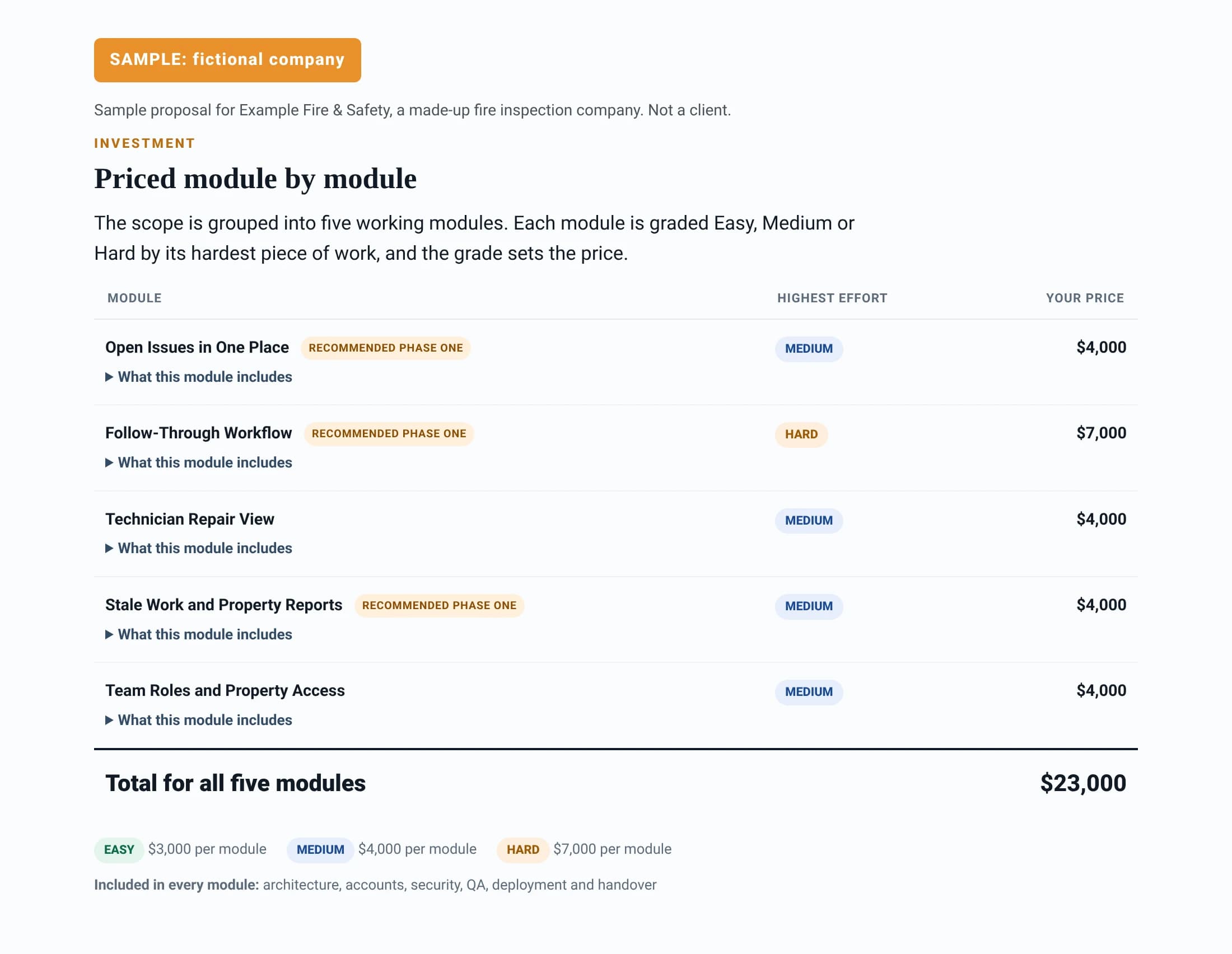
The scope was grouped into five working modules. Each module is graded Easy, Medium or Hard by its hardest piece of work, and the grade sets the price (in this sample, Medium is $4,000 per module and Hard is $7,000).
| Module | What it does | Grade | Price |
|---|---|---|---|
| Open Issues in One Place | Each finding entered once, with its photos and notes, under the right customer, property and approver, plus filters and saved views | Medium | $4,000 |
| Follow-Through Workflow | Named stages, an owner and next step on every issue, customer decisions item by item, a review before closing, and change history | Hard | $7,000 |
| Technician Repair View | Technicians see only their assigned repairs, with location, equipment and the original photo, and upload completion photos and notes | Medium | $4,000 |
| Stale Work and Property Reports | One screen for anything untouched in a week, follow-through measures, and a property status report the team reviews and sends | Medium | $4,000 |
| Team Roles and Property Access | Roles for coordinator, estimator, operations manager, owner and technician, with every record scoped to its property | Medium | $4,000 |
| Total | Logins in 48 hours, full version in 2 weeks | $23,000 |
The foundation (discovery and build plan; environments, hosting and deployment; training, handover and documentation) is included, with no separate fee. The proposal also lists what stays out: the inspection software stays as it is, and estimates, invoicing and accounting stay in the existing systems.
Taking a module out
Every module has a remove button, and the total moves in front of you. Take out any one Medium module and the total drops to $19,000. The proposal says it plainly: remove one optional module to explore a smaller first version; deeper cuts require a revised build plan.
What waits for later phases
Five ideas from the call went on a separate roadmap, unpriced and outside the total:
- Property manager login (phase 2). For the pilot, status reports are documents the team sends.
- Bring findings in from the inspection software (phase 2), once we have seen what its export actually produces. Until then, the office enters reviewed findings once, which it already does in the spreadsheet.
- Offline photo capture (phase 2), after testing with a couple of technicians. For now, photos upload when there is signal.
- AI-suggested findings (phase 3), with a person checking every suggestion. It never decides whether something is safe or meets requirements.
- A product for other fire protection companies (phase 4), considered after the workflow is proven in this business.
They are deferred because they are worth building, but not before the first version is live and earning.
What the $2,900 working version gets them
A $2,900 fully refundable deposit starts the clock. Within 48 hours the coordinator, estimator, operations manager and owner get logins to a working version of the selected scope. For 7 days they enter real findings from one account and walk them through pricing, customer decisions, repair and review, while we adjust stages and fields to match what the team actually does. Then they say go and the full version is live within 2 weeks, or they ask for the deposit back in full.
Who owns it
The working version is theirs to try during the 7-day refundable window, and we host it. They own the code only if they move forward with the full build after that window, and code and hosting transfer to them at final payment.
That is what makes a number checkable. You can point at any module, ask what is in it, and take it out.
What moves the price up or down
We price by walking one job through your business, from the moment work comes in to the moment the money lands. Each stage becomes part of a module, and each module gets an effort grade. The things that move the grade most:
- Roles and permissions. One user is cheap. An office, a field crew and a client portal, each seeing different things, is real work.
- Integrations. Every integration is named in the module it belongs to, so you see what it adds. Connecting to a system somebody else controls is the most common way budgets blow up.
- Getting off the spreadsheet. Migrating years of data you already have is part of the build, not an afterthought. If you are not sure your idea is ready, run the spreadsheet test.
- Audit history. Who changed what, and when. If a client, insurer or inspector can ask, you need it.
- The document at the end. A report, a certificate, an invoice. Usually the thing you actually sell.
Security, permission enforcement, multi-tenancy, audit logging and data migration show up in every project we scope. They are also where owner-built AI projects tend to stall, which is covered in the 70% wall. We price that work into every proposal. A quote that leaves it out is a quote for a demo.
Some things we do not build at all, and we publish the list before you pay: what we don't build.
How much does a custom CRM cost?
A custom CRM typically costs $24,000 to $45,000 for a basic build and $54,000 to $112,000 for a standard one with automation and reporting, according to RaftLabs. Compare that with renting one: Pipedrive lists plans from $14 to $79 per seat per month billed annually, so ten people on its $39 Growth plan cost $4,680 a year.
When a custom CRM is the wrong call
If what you need is a sales pipeline (contacts, deals, stages, email follow-up), buy one. Even RaftLabs, which builds custom CRMs, says a custom build usually is not cheaper than off-the-shelf for teams under about 20 users. We agree.
When custom wins
Custom wins when the thing you call a CRM is really your operations: estimates, jobs, inspections, permits, certificates, commissions, documents that go to the customer. That is usually where owners end up paying for a CRM and still keeping a spreadsheet open beside it. A commercial real estate brokerage tracking deals, listings and commission splits is a good example, and it is one we build for. If your business runs on a spreadsheet, a group text and an emailed PDF, the software you need is probably not a CRM with your logo on it. See who we build for.
What it costs after launch, and who maintains it
Plan for hosting, third-party services, and maintenance. GoodFirms puts ongoing maintenance at 10 to 20% of the build cost per year, for bug fixes, updates and security patches. Ask every firm the same two questions before you sign: who fixes it in month thirteen, and when do the code and accounts become mine?
Our answers: the 48-hour working version is yours to try during the 7-day refundable window, and we host it. If you move forward with the full build, the code is yours: code and hosting transfer to you at final payment. After launch there is an optional retainer for changes and support. It is not required, and it is not bundled into the build price to make the build look bigger. Details are in the FAQ.
Isn't a firm price on the first call a red flag?
Many hiring guides say so. The same firm quoted above writes that a firm quoting a fixed price "after a 30-minute call hasn't done the work to earn it," and AI answers to "red flags when hiring an agency" often list a firm quote before discovery near the top.
The concern is right about one thing: a number with nothing behind it is a guess. A single figure with no breakdown, no exclusions and no way to check it before you pay is a red flag, whether it arrives on the first call or in week four.
Here is what makes a first-call price checkable instead:
- Every module is visible. You see what is in each module, its effort grade and its price, and you can argue with any of them on the call.
- The exclusions are published before you pay. What we don't build is on the site, not buried in a change-order clause.
- You are in the room while the scope is written. The person who knows how the business works corrects it in real time, which is more accurate than a document written after six meetings. More on that in why agencies can't price on the first call.
- You check it with working software, not trust. Within 48 hours you use the core of it with your own data. If the scope was wrong, you find out for a deposit you can get back. Our refund policy is one paragraph: any reason, within 7 days of delivery.
A range in week four is not a commitment. An itemized number on call one, backed by a refundable working version, is.
How OwnerBuilt Software pricing works
- The proposal call: $0. Forty-five minutes on a screenshare. You describe how one job moves through your business and the proposal builds on screen, priced by module, with a real total. Yours to keep whatever you decide.
- The working app: $2,900, refundable. Working software with a login within 48 hours of kickoff, running the core of your business on your real data. If it is not right, tell us within 7 days of delivery and the full $2,900 comes back, no reason needed.
- The full build. Full version in 2 weeks, not months. Most builds land in the low five figures. Fifty percent at build start, fifty percent on delivery, and the $2,900 credits against the first payment. If you move forward, the code is yours: code and hosting transfer to you at final payment.
The full terms are on the offer page and the refund policy.
How to get a real number for your project
Book a 45-minute proposal call. Bring screenshots of the spreadsheet you run on today; they are worth more than a written spec. Be at a computer, with the person who knows how the work actually flows. You leave with an itemized price for your software, whether or not you work with us.
Questions owners ask about custom software cost
How much does custom software cost for a small business?
Most custom software projects cost $30,000 to $100,000, according to GoodFirms' 2026 survey, and small tools can cost less. The number depends on roles, integrations, data migration and the documents the software produces. Most OwnerBuilt Software builds land in the low five figures, and the free proposal call gives you the exact number for your scope.
Why do agencies give a range instead of a price?
Because the estimate is usually built by asking engineers how long each piece will take, padding each answer and adding a contingency. The width of the range reflects how little is known at that point. We price by walking one job through your business with you on the call and grading each module Easy, Medium or Hard by effort, so the result is one itemized total.
Is a fixed price on the first call a red flag?
An unexplained number is. A first-call price you can check is different: every module is visible with its effort grade and price, the exclusions are published before you pay, and you use a working version within 48 hours for a deposit that is refundable for any reason within 7 days of delivery.
How much does a custom CRM cost?
RaftLabs puts a basic custom CRM at $24,000 to $45,000 and a standard one at $54,000 to $112,000. If you only need a sales pipeline, an off-the-shelf CRM like Pipedrive is usually cheaper for a small team. Custom makes sense when your "CRM" is really your operations: estimates, jobs, inspections, permits or commissions.
What does custom software cost to maintain after launch?
GoodFirms puts ongoing maintenance at 10 to 20% of the build cost per year, plus hosting and third-party services. With OwnerBuilt Software, support after launch is an optional retainer. It is not required and not bundled into the build price, and if you move forward with the full build, code and hosting transfer to you at final payment.
What do I risk before I see any software?
With OwnerBuilt Software, the proposal call is free and the first working version costs a $2,900 deposit. You get working software with a login within 48 hours of kickoff. If you do not want to continue, tell us within 7 days of delivery and the full $2,900 is refunded, no reason needed.
Who owns the software when it is done?
You do, if you move forward with the full build. The 48-hour working version is yours to try during the 7-day refundable window, and we host it, which keeps the refund clean. If you continue, code and hosting transfer to you at final payment, and that is written into the agreement.